EVOC

Supporting the people and communities of Edinburgh since 1868.

Menu 
  • Home
  • About Us
    • Vision, purpose and values
    • Contact Us
    • Board
    • Staff
    • Membership
    • Reports and Consultation Responses
    • Vacancies
    • Edinburgh’s TSI
  • Forums & Networks
    • Carers Forum
    • Chief Officers Group (Edinburgh)
    • Children, Young People & Families Network
    • Disability Forum
    • Mental Health Forum
    • Older People’s Service Providers’ Forum
    • Place-based Networks
    • Social Enterprise Network
    • Strategic Place Forum
  • Our Work
    • Children, Young People & Families
    • Edinburgh’s Response to Ukraine
    • New Scots Edinburgh Refugee Integration Strategy
  • Funding
    • Current Funding Opportunities
    • Edinburgh Community Lottery
    • Community Benefit Gateway
    • Communities Mental Health & Wellbeing Fund
      • Communities Mental Health & Wellbeing Fund: Year 5
      • Communities Mental Health & Wellbeing Fund: Year 4
      • Communities Mental Health & Wellbeing Fund: Year 3
      • Communities Mental Health & Wellbeing Fund: Year 2
      • Communities Mental Health & Wellbeing Fund: Year 1
  • Training
    • Our Commitment to Quality Training
  • Need Help?
  • News
    • Events, Seminars, & Workshops
    • EVOC Blog
    • Our Latest E-newsletters
  • Noticeboard
You are here: Home » Archives for Blog Posts

EVOC attends Social in the Gardens 2018

21 August 2018 By EVOC Communications Team Leave a Comment

By Alea Ibrahim, Communications Intern for EVOC 150 Heritage Programme.

The EVOC150 team seized the tropical Edinburgh weather last Friday and visited Social in the Gardens, organised by Edinburgh Social Enterprise.

Locals and people from all over the world enjoyed a jam-packed entertainment programme of Highland dancing, storytelling and music until late in the evening.

Social enterprises are set up like other businesses but use the profits to reinvest into causes with a social impact. Some of Edinburgh’s social enterprises joined the event to showcase their work and volunteers from across the city were socialising with the visitors.
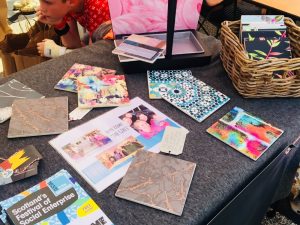
Cooking Classes with Cyrenians Good Food

Manning the Cyrenians stall Viki Fox, Cookery Tutor, of Cyrenians’ Good Food Programme said that since Prue Leith from the Great British Bake-Off opened the brand-new, purpose-built Good Food kitchen in Jane Street at the beginning of the year, they have had a busy programme.

Viki said: “We are teaching cooking classes funded by the council and we are doing evening classes for adults, the money made from that goes back into the service. We do kids classes during the summer holidays and there is a supper club for refugees trying to get a business going.” Cyrenians is currently celebrating their 50th anniversary of supporting Edinburgh’s vulnerable citizens with a large network of services.

Business Advice to Ice-Cream

Michelle Craig, from Citizens Advice Scotland attended the event to promote the organisation’s services, but also ended up giving some fairly unusual advice. She said: “Many were interested in advice and services on how to set up their own business but we give advice on anything really. Someone needed advice on where the nearest ice-cream was.”

Invisible Cities taking a stand

Invisible Cities trains homeless citizens as guides who create their own tours around the city while the organisation helps them back on their feet, into employment and housing.

Alice from Invisible Cities, explained how one of their trained guides had turned his situation around, she said: “ The guide and his son had been homeless and on benefits due to a range of unfortunate circumstances when they came to Invisible Cities but it was really important for him to come off benefits. He became a tour guide and recently started a new job as a chauffeur, he was working until 3 o’clock this morning before coming here. That’s dedication for you!”

In keeping with Edinburgh’s other festivals, this year’s Social in the Gardens had an international focus. Alice continued: “We receive inquiries from all over Europe, a lady from Australia approached us today and wants to do something similar there.”

A call for social justice

Edinburgh Social Enterprise has been organising this since 2014 but this year has been a remarkable success with over 30 stalls and 160% more visitors than in previous years.

Chatting to people on the stalls reflects that while a lot of organisations are working to tackle social inequality, poverty and homelessness, the problems still prevail. Edinburgh Voluntary Organisations’ Council grew out of concern over the health and social inequalities between people in the city. Founded in 1868, it is now celebrating its 150th year.

EVOC150 is marking this year with a series of collaborations and events, to strengthen the third sector and continue the fight for social justice

Follow our programme, find out how to be involved and spread the word. Twitter: @evoc_edinburgh and use the hashtag #EVOC150

Why Pride is the Essence of Community Powered Civic Action

19 June 2018 By EVOC Communications Team Leave a Comment

Saturday (16th June) marked Edinburgh’s celebration of Pride.

Thousands of LGBTQ+ people and their allies marched from Holyrood, up the Royal Mile, over George IV Bridge and out on to Bristo Square dressed to impress, wearing glitter and smiles.

Although Pride has become synonymous with glitter and rainbows, there is a deeper meaning to why people march and where Pride started. In the sea of rainbow flags and happy faces, people held up signs that read: ‘Trans Rights now’, ‘Support Trans Women of Colour’ and calls to have rights recognised and respected for all people no matter their ethnicity, gender or sexual orientation.

Pride started as a deeply political act of civil unrest against the systematic oppression of LGBT people. It has continued through to the present day, not only as a celebration of how far things have come, but also as a reminder that more work needs to be done for LGBTQI+ people to feel fully included in their communities and have their rights respected.

Tackling Inequality

EVOC has been campaigning for social justice and tackling inequality for 150 years, and although these efforts have been centred on issues like sanitation, housing conditions and health and social care – the ethos behind these campaigns is the same. That we must work together to make our environments and our communities a better place, for everyone.

Halfway up the Royal Mile, speeches were heard. They too focused on Pride as a celebration, but also on Pride as political, as an opportunity to take the time to be reminded of how far there is to go.

Patrick Harvie, Green MSP for Glasgow and co-convener of the Scottish Green Party, delivered his speech and commented that “Scotland was one of the worst places to be LGBT, but is now one of the best.”

Homosexuality (between men) was only decriminalised in Scotland in 1980, and the first Pride march was held in 1995.

After the crowd cheered, he reminded listeners of the gains still to be made for marginalised groups and joined the crowd in chants of ‘Trans Rights Now’, promising to work to push through legislation that would protect the rights of transgender people in the Scottish Parliament.

Intergenerational Learning

As well as political figures, the Third Sector was also represented which of course has been at the centre of fighting for equality in the city for generations. Tim Puntis of LGBT Age, a project that supports older LGBT people, gave an impassioned speech, outlining the issues of invisibility that this group face, whether that’s isolation or having to hide who they are to access essential care services.

Tim urged the younger generation to thank their elders in the community for their hard work and relentless pushes for progress, tolerance and acceptance paving the road for gains that once seemed unimaginable. He spoke about a spirit of intergenerational learning, and carrying on the fight for equality.

EVOC’s 150th Anniversary year, will not only be about uncovering the heritage of social justice but also be about inspiring young people to take action and to challenge the status quo for the betterment of their communities.

We will do this through an exciting programme of events and activities that will include people from all sections of society and exploring how we can learn from the history of our city’s third sector.

From civil disobedience, to protest, to celebration Pride embodies the essence of fighting for social justice through civic action, and this year’s event in Edinburgh was prudent to look to the past to inform what still needs to be achieved.

To find out more about EVOC at 150 years old visit the website – www.evoc150.org.uk


Guest Blog: Scottish Older People’s Assembly

30 April 2018 By EVOC Communications Team Leave a Comment

Glenda Watt from The Scottish Older People’s Assembly provides a guest blog on SOPA in Parliament

Clare Adamson MSP, Tom Berney Chair of Scottish Older People’s Assembly and Jeane Freeman OBE MSP and Minister for Social Security began the proceedings of our 9th Assembly in the Scottish Parliament on Monday 23 April 2018.

We had an overwhelming response to attend our event but sadly could not accommodate everyone who applied. However, amazingly, 130 people did participate in our four workshops dealing with: Funeral Poverty, Bevridge’s Giant Five Evils – where are we now?, Sustainability of Adult Social Care, the Prevention and Management of Falls, and Scams Towards Older People.

To celebrate 2018 as the Year of Young People, the afternoon session opened with a lively interactive discussion on Human Rights with members of the Children’s Parliament, Scottish Youth Parliament and Scottish Older People’s Assembly. Alison Johnstone MSP and Clare Adamson MSP closed the session with a Question Time.

It certainly appeared that the guests enjoyed the event and the following comment from Dundee Voluntary Action was a treat to receive -“We thoroughly enjoyed our first Scottish Older People’s Assembly yesterday. It was a fabulous day with great discussion. We look forward to working closer with you this year.”


What it’s like to be a Trustee

23 April 2018 By EVOC Communications Team Leave a Comment

My main motivation, initially, for getting involved in charities, was that I had recently moved to Edinburgh and didn’t know anyone in the City aside from my new work colleagues. I joined a charity as a volunteer and after finding out they were looking for a new treasurer, decided to join their board of trustees.

I hadn’t volunteered as a trustee before, but I had always been involved in students’ union work whilst at university, it seemed like a natural progression to go sit on a board after graduating. No one paid me to say this, but, going on EVOC’s training for charity trustees was hugely beneficial – I admit I was pretty clueless about charity rules and regulations, I had jumped into the role a bit head first!

New Responsibilities

Thankfully, I had supportive fellow board members beside me to help me learn about my new role and as I was working in a junior position at work, I enjoyed the new responsibilities that the role gave me. Working with the charity gave me invaluable experience; from grant writing, to writing business plans and understanding HR. I’m not going to lie and say it was plain sailing, it was an incredible learning curve, especially when I became co-chair with a fellow trustee.

Volunteering as a trustee gave me experience and examples of much higher level work than my paid job did, which helped me greatly when looking for new jobs and progressing my career. It also broadened my horizons outwith my career in admin. It gave me greater work-place resilience, made me realise my own capabilities and helped improve my own self-confidence. I volunteered with the charity for over two years as a trustee, and it was a difficult decision to step down when I did. I’ve since been volunteering in non-trustee roles, but I am currently looking into joining another board in the near future.

The Women Who Shaped Edinburgh’s Social Welfare

8 March 2018 By EVOC Communications Team Leave a Comment

Edinburgh Voluntary Organisations’ Council reaches the grand old age of 150 this year. From April, we intend to spend much of the next year researching the reason for EVOC’s formation, the social and civic context it operated within, and the extraordinary people that have been involved the Organisation in some way or another.

With that in mind, a couple of weeks ago I donned my heritage hat and headed down to Edinburgh Central Library with our Convenor to rummage around some of our archives. Admittedly, having glanced the titles of the documents on our inventory, I was a little concerned that my morning would consist of wading through 150 years of dry meeting minutes. I needn’t have worried however as one of the first documents to grab my attention was a personal letter from Octavia Hill* to Helen Louisa Kerr.

Helen Louisa Kerr was a formidable woman, a social worker and researcher she was at one time the Director of the Edinburgh Social Union. Her knowledge of social reform and housing lead her to become the only female member of the Royal Commission to enquire into Housing of the Industrial Population of Scotland in 1912. She conducted a series of lectures on poverty and wrote the preface for Dr Chalmers and the Poor Laws 1911. She was appointed a Manager of the Edinburgh Royal Infirmary, pushed for the establishment of a Scottish Board of Nursing, and worked to further the professionalisation of nurses.

In the correspondence Hill praises Kerr and the Edinburgh Social Union for their work on the regeneration of housing for the poor, stating “I know how, in your place, I should long to do the work; I know well how incomparably better done it would be by you and yours”.

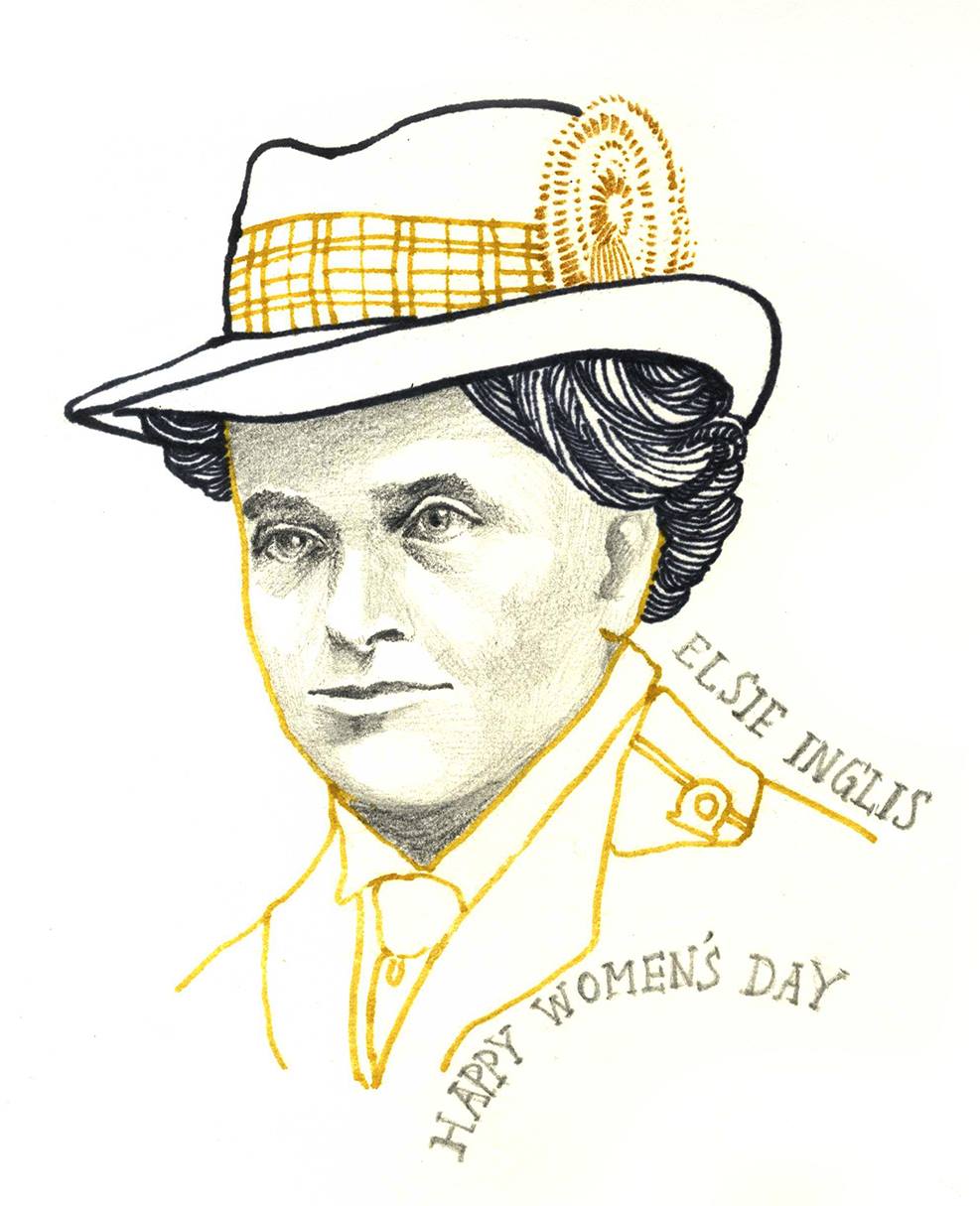
Elsie Inglis Illustration

Illustration by Katrine Lyck – HB Artivists – see link at the bottom of the article

In the Third Annual Report of the City of Edinburgh Charity Organisation Society 1909, the name by which EVOC was known at the time, Kerr is listed as an Honourable Secretary. This is a remarkable document, not only because it details the collaborative relationships between statutory, public, academic and charitable organisations, but also because it highlights the work of women in Edinburgh in their mission to improve the welfare of the City’s citizens. In a section titled ‘The Prevention of Infant Mortality’, which discusses the work to improve the health of new-born babies by voluntary organisations and the City Council, we learn that Dr Elsie Inglis arranged a series of lectures to health visitors and mothers.

Dr Elsie Inglis (1864 – 1917) was one of Scotland’s most influential suffragists, and was secretary of the Edinburgh National Society for Women’s Suffrage, and honorary acting secretary in the early years of the Scottish Federation of the National Union of Women’s Suffrage Societies. After studying at the Edinburgh School of Medicine for Women which was opened by Dr Sophia Jex-Blake (of Edinburgh Seven fame), Inglis went on to dedicate much of her medical career to improving the healthcare provision for female patients. She studied and qualified from a number of leading hospitals for the improvement of women’s health and returned to Edinburgh to set up a maternity hospital for poor women, a midwifery training centre, and used her connections in the suffrage movement to raise money for the Scottish Women’s Hospitals. During the First World War Inglis created a Medical Unit staffed by qualified women, and offered their services to the Royal Army Medical Corps. The offer was declined, rather condescendingly, by the War Office, yet the merit of the Unit was recognised by the French government and they were deployed in Serbia.

To see the names of these incredible women, amongst many others, mentioned in documents that relate to our Organisation’s history is humbling to say the least. While I feel as though we have only just scratched the surface, I hope through further research we find more out about the women that have fought for the welfare of our citizens, that we give them the recognition they deserve, and we celebrate the women today who continue their legacy.

Would you be interested in this supporting this research? Let us know by contacting [email protected]

While I would love to list every great organisation, movement and project that support and champion women in Scotland, I can’t, but here is a selection of links that I think are a good place to start:

Lothian Women’s Forum (who have a very helpful page on Helen Kerr): https://www.wealothianwomensforum.org.uk/
Engender Scotland: https://www.engender.org.uk/
Equate Scotland: https://www.equatescotland.org.uk/
Fearless Femme: https://www.fearlessfemme.co.uk

Finally – a big International Women’s Day shoutout to all of the charities and organisations working tirelessly for women’s rights, safety and wellbeing in our City. You know who you are!

For illustrations of great women follow HB Artivists on Instagram

Follow us on twitter @Evoc_Edinburgh

*Octavia Hill (1838 – 1912) was credited with being the driving force behind the development of social housing, a founder of the National Trust and founding member of the Charities Organisation Society. Her approach to social housing, known as the Octavia Hill system, employed women to collect rent and care for the welfare of the residents as much as the condition of the buildings.

Isn’t it great when things really are learnt from good practice?

19 December 2017 By EVOC Communications Team Leave a Comment

Isn’t it great when things really are learnt from good practice? 

When my colleague Katherine, David (from the Cooncil) and I set off on our 6 hour round train trip on a Friday morning to North Ayrshire I wasn’t absolutely convinced it was great use of more than one third of my working week hours – I could feel the emails stacking up in the inbox in the office.  It was a grey, bleak day and David had finished his lunchtime butties before we had even reached Haymarket… (you know the kind of trip).  We had heard that North Ayrshire Council had managed to get brilliant engagement with young people when they ran a participatory budgeting for youth work in the area. Over 50% of young people in North Ayrshire had voted, which translated into around 5000 participants between the ages of 12 – 25.  That is pretty impressive stuff, and we wanted to find out more.

Donna, the ‘one woman turbo engagement machine’ from North Ayrshire Council was responsible for running the show, was also impressive, but in her own words ‘not always popular’, when she added to the workload of the schools in the area.  Events were run in each locality and young people voted in schools, youth centres/clubs, residential units, job centres, homeless hostels etc.   In schools the voting was built into the school timetable – so they weren’t just relying on lunchtime activity.  Donna saw no barriers to participation that couldn’t be crashed through with a little effort and understanding, they hadn’t got it all right straight away but every year they were getting better.  Social media was used extensively to promote the voting, and a promotional video created for each project by the Council, so that each project could be promoted consistently, rather than expect projects to market themselves which can have varying outcomes depending on skill. 

The youth PB project was promoted as not just being about voting but active citizenship, community cohesion/participation.  As my 11-year-old is coming home with tales of how she is learning about parliament and voting, and how it’s all a bit dull, I try to instill in her how exciting it can be if you keep it real and believe that people can have a say. By being able to play her part in democracy rather than just hearing the theory might just make the difference to how engaged she is in the future. 

What have we learnt?  Well since that trip the Council have made some changes to their plans for the voting in the Participatory Budgeting Choose Youth Work 2018-2019 Grants programme.  This year Andy Gray, Head of Schools and Lifelong Learning, has written to all Edinburgh’s secondary head teachers asking them to nominate a teacher or member of staff with whom the steering group for Choose Youth Work 2019-19 can liaise directly and organise the voting.  

Perhaps taking the time out of our day to visit North Ayrshire PB made the difference, perhaps a bit like PB we needed the time to prepare and reflect for us to really take on the information, to make something happen and to make an impact.

With any luck we will see a real difference to the level of engagement with young people this year as they vote for the projects that they think sound like what they need.  The truth, of course, is in the participation in the voting…and we won’t hear back about that until the votes are cast in March.  Watch this space.       Read more here

Constructing Space

24 November 2017 By EVOC Communications Team Leave a Comment

When I welcomed you to the Conference on 7th November I said our ambition was to challenge you.  I was clear that over the next 3 to 5 years things were probably going to get beyond tough.  We know that public funds will diminish, other funders have reducing resources and we have increasing demand.   So in time honoured tradition our Sector must be and will be at the forefront of thinking and doing things differently.  We know from our research at EVOC that most organisations have worked hard over the last few years to diversify their funding streams but are we still doing the same things with the funds? 

I hope you were suitably challenged!  I hope that you found the day inspiring and invigorating but more importantly I hope you will take time to reflect on discussions you had during the morning and rise to the challenge of change.

Thank you to Diarmaid Lawlor, Director of Place at Architecture and Design Scotland who kicked off the Conference by talking about the importance of our physical surroundings and how they influence the space in which we speak, think, learn and create. He introduced the concept of authorising environments and how we often overlook how we welcome people to such spaces. Authorising environments, when done well,  can be a powerful acknowledgement of a person’s or a community’s feeling of inclusion and engagement.

Diarmaid's Slides

View and download Diarmaid’s slides.

We were joined in the afternoon by the Leader of City of Edinburgh Council, Councillor Adam McVey, who gave an overview of City of Edinburgh Council’s current activities and 52 pledges they aim to fulfil throughout the term of the administration. He emphasised the £21 million of cuts the Council will have to make by 2018/2019 and the further savings of £150 million by 2023. 

Talking to the issues raised in our manifesto Everybody’s Edinburgh, Councillor McVey discussed the creation of a homelessness task force and the Council’s pledge to build 20,000 affordable homes over the next five years. He went on to highlight the growing population of Edinburgh, the impact this will have on service provision and housing, and the need for the Council to work more collaboratively with the third sector to meet the needs of our citizens. Councillor McVey also recognised the unequal impact of current procurement processes and that more needs to be done to find a way to mitigate this inequality. 

Special thanks to all those who attended our workshops, your input was invaluable. We are currently processing the feedback which will inform the next stages of work, and we will be in touch over the coming months. 

Our facilitators have provided a brief overview of the sessions and their outcomes:

Prevention within the Context of Grants Review and Funding Cuts

Doing Things Right Means Doing the Right Things

Participatory Budgeting an Effective Tool for Community Engagement? 

Partnership Working with School Communities

Social (in)security?

“Doing things right means doing the right things”

24 November 2017 By EVOC Communications Team Leave a Comment

This tongue twister of a workshop title comes from a Governance Institute paper called “Cultural Markers: Assessing, measuring and Improving Culture in the Charitable Sector”. I think it really captures the essence of good governance and why it’s so important and this was the focus of this workshop at our Conference.

We had a discussion about what good governance is, how it’s achieved, and some of the reasons it can be so difficult. Some of the fundamentals of a well-run board that workshop attendees identified were: trustees who understand their role, transparency, trustees who share the values of the organisation, good policies and structures – and ensuring they’re followed, inclusion, and a culture of healthy debate. Whilst these points are the ideal, we also identified some of the challenges to achieving these such as:

  • trustees who lack time or commitment;
  • trustees who don’t understand the role;
  • disinterest or lack of understanding of the finances of the organisation;
  • poor organisation – board papers not going out on time;
  • not having a good understanding of the risks to the organisation or how to mitigate them;
  • and the constitution not being referred to, understood, or being out of date.

Some of these can seem fairly minor, but in fact, they can create significant weak points in the organisation that can have serious implications.

We also discussed the importance of the relationship between the board and the senior management of organisations. Everyone had different ways of ensuring that relationship worked well – for some it meant having occasional board meetings where senior management don’t attend, for others they have a trustee only meeting for the first 30 minutes and senior management join after that. It highlighted the fact that very often there are not hard and fast rules for organisations to achieve the ideals of good governance – it’s up to the trustees to figure out what works best and to have the flexibility for that to change over time.

The workshop attendees were people from organisations just starting out and people who have been on boards or worked for charities for a long time, very small entirely volunteer-run organisations and larger ones. With such a diverse range of experience in the room, it was a good opportunity to have discussions about common issues and practical solutions that we found have helped in real life situations. As a bonus, our icebreaker was to name a favourite film so I’m hoping everyone came away with some good movie suggestions for the weekend!   

If you have specific queries you would like answered, then you can contact our Organisational Development team by filling in a referral form. 


Social (in)security?

24 November 2017 By EVOC Communications Team Leave a Comment

At our Conference, Scottish Government presented an overview of the current landscape in terms of the devolution of £2.8bn of benefits from UK to Scottish Government, the new agency which will be established and the Experience Panels which have been set up to allow those with lived experience of the current benefit system to inform this process.

There was a discussion covering the following issues:

  • Organisations are experiencing an increase in both the level of support needed and the number of people needing support.
  • The risk of sanction when participating in volunteering and other opportunities which improve wellbeing.
  • The benefit of welfare rights advice and advocacy services.
  • Fundamental issues with the assessment process whereby such a short process can often be used to make knee-jerk judgements.
  • The basis for targets which are seen to work against people’s best interests – for example, the DWP’s target to refuse 80% of mandatory reconsiderations (especially considering that in Edinburgh 75-80% of appeals are successful.
  • The need for the new agency to try to address stigma and the culture which has been established around the receipt of benefits.
  • How to help seldom heard communities have a meaningful voice in terms of influencing the new system in Scotland.

We agreed to remain actively in discussion as the new agency forms and follow up on specific opportunities to engage seldom heard communities.

Prevention within the Context of Grants Review and Funding Cuts

24 November 2017 By EVOC Communications Team Leave a Comment

In light of the forthcoming review of the Health and Social Care grants programme, we facilitated a workshop at our Conference to investigate the merits of a third sector lead Commission on Prevention.  The busy workshop explored issues and voiced opinions on what exactly we mean by ‘prevention’ and how might the third sector effectively lead on promoting the agenda through such a commission:

  • Objective: to demonstrate what prevention would look like in Edinburgh, and to encourage collaborative work to move resources to recognisable preventive measures
  • Strategy: to listen and gather evidence from individuals on what preventative measures would help them in their particular circumstance, (circa 500 Edinburgh citizens)
  • Considering: Existing preventative spend – is it working and enough?

We asked what role grants play in promoting prevention and what do we know works well.

The results of the workshop are being written-up into a short report that will then be considered by Third Sector Strategy Group (TSSG) and inform the development of the Commission.

  • « Previous Page
  • 1
  • …
  • 6
  • 7
  • 8
  • 9
  • 10
  • …
  • 22
  • Next Page »

View Notices by Category

About EVOC

  • EVOC Staff
  • Board & Trustees
  • Edinburgh’s TSI
  • Terms of use
  • Privacy Policy
  • Vacancies

Contact Us

EVOC, 61-63 London Road, Edinburgh, EH7 6AA

Get in touch

Facebook
X (Twitter)
LinkedIn
Eventbrite

Cyber Essentials Certified
Quality Scotland Logo
Living Wage Logo
OSRC Registered Charity - SC009944

Copyright © 2026 · EVOC is a company limited by guarantee No. SC173582 and is a registered Scottish charity No. SC009944.